

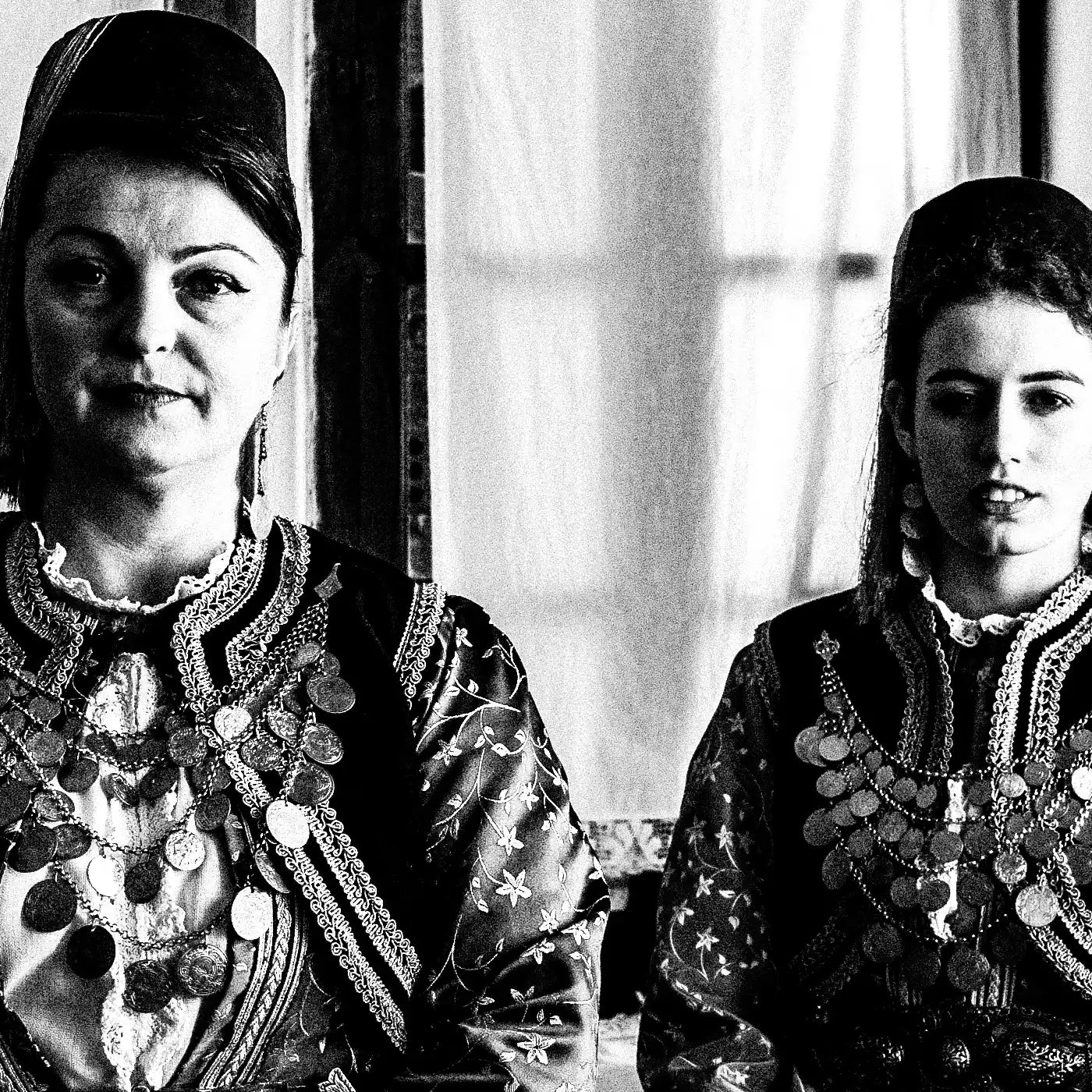

Bedroom Interior, Kastoria is a black and white fine art photography print by George Tatakis. From the Caryatis series. Produced on Hahnemühle Baryta Photo Rag 315gsm using archival pigment inks. Open edition, with signed and framed options. Each print is house-stamped on the reverse. Available formats: 30 x 20 cm, 42 x 30 cm, 60 x 42 cm. Choose print only or a black oak frame.
Photographed in Kastoria, this image is built on depth, layering, and controlled asymmetry.
Two figures are placed along the central axis, but not equally. The front figure occupies more visual weight, while the second sits slightly recessed, introducing a clear spatial hierarchy. This creates depth without breaking the stability of the composition.
The bed acts as the primary horizontal plane, grounding both subjects. It extends across the frame and connects the two figures into a single structure rather than separating them.
Behind them, the doorway forms a secondary frame. It encloses the rear figure while reinforcing the central alignment of the composition. This layered framing—foreground subjects, mid-ground bed, background doorway—creates a clear progression into space.
On the right side, the window introduces directional light. It defines the faces and garments while leaving parts of the room in softer shadow. The vertical wooden column acts as a visual boundary, containing the light and preventing it from dispersing across the frame.
Objects in the foreground, including the vessel, add a final layer. They extend the composition toward the viewer without interrupting the balance of the scene.
The image relies on controlled imbalance. Elements are not mirrored, but carefully distributed to maintain cohesion.
Part of the Caryatis series, a long-term body of work exploring traditional Greek costume through directed portraiture.