

Charapides, Pagoneri is a black and white fine art photography print by George Tatakis. From the Ethos series. Produced on Hahnemühle Baryta Photo Rag 315gsm using archival pigment inks. Open edition, with signed and framed options. Each print is house-stamped on the reverse. Available formats: 30 x 20 cm, 42 x 30 cm, 60 x 42 cm. Choose print only or a black oak frame.
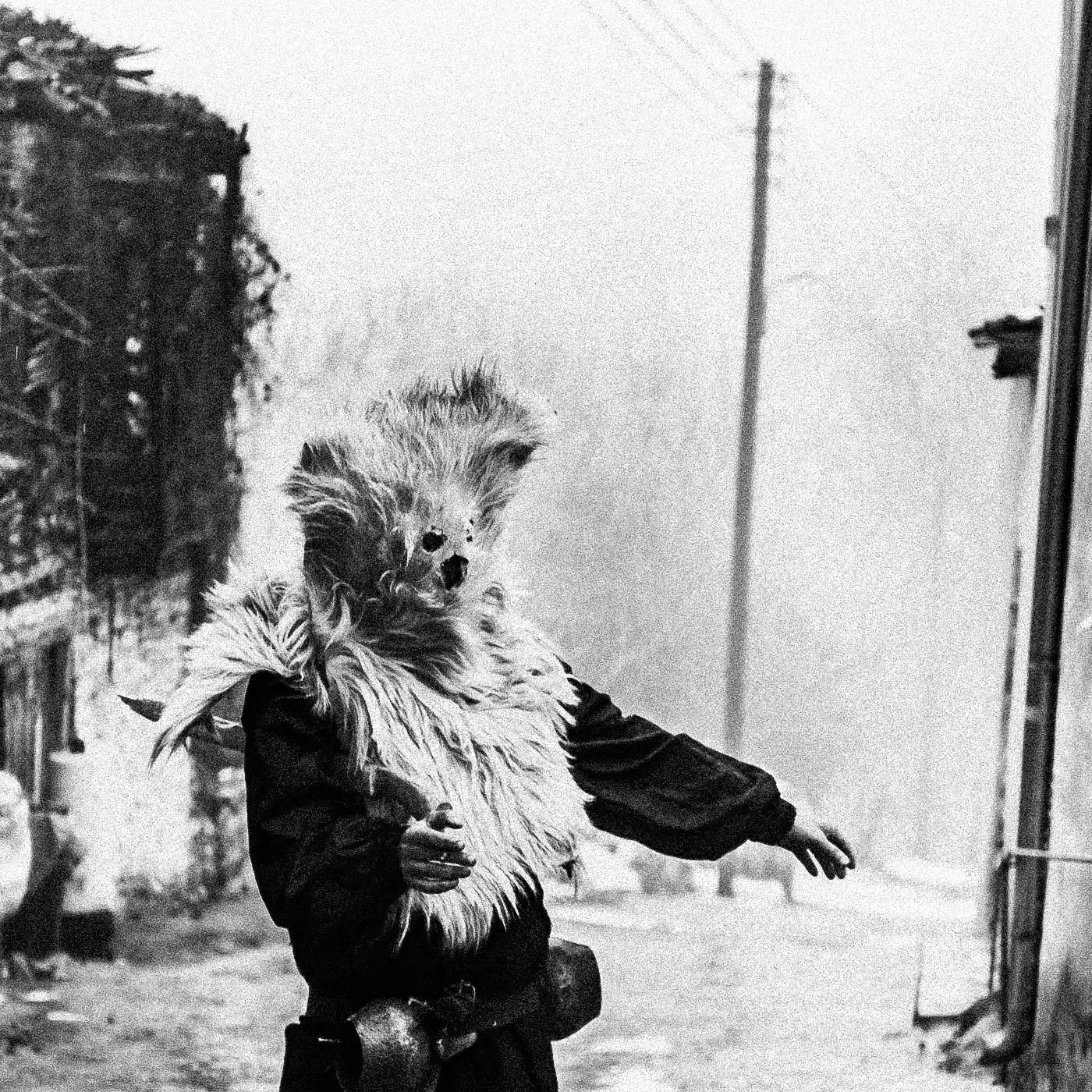
Photographed in Pagoneri, Drama, this image captures the Charapides custom during Epiphany.
A single figure moves through a narrow village street. The body is mid-motion, slightly blurred, breaking the stillness seen in other works.
The composition is built on depth. The street recedes into the background, creating a corridor that directs the movement of the figure.
Walls on both sides frame the path, forming a contained space. The figure is not isolated but embedded within the structure of the village.
The costume—fur, mask, and bells—remains central. Its volume contrasts with the linear geometry of the street.
Motion introduces instability. The figure is not fixed, and the image captures a moment rather than a pose.
The ground is wet, reflecting light and adding texture to the lower part of the frame. This reinforces the direction of movement toward the camera.
The mask removes identity, transforming the subject into part of the ritual rather than an individual.
The Charapides custom is closely related to the Arapides tradition, a Dionysian ritual performed during Epiphany, associated with protection, renewal, and transition.
Part of the Ethos series, a long-term body of work documenting Greek rituals and cultural practices.