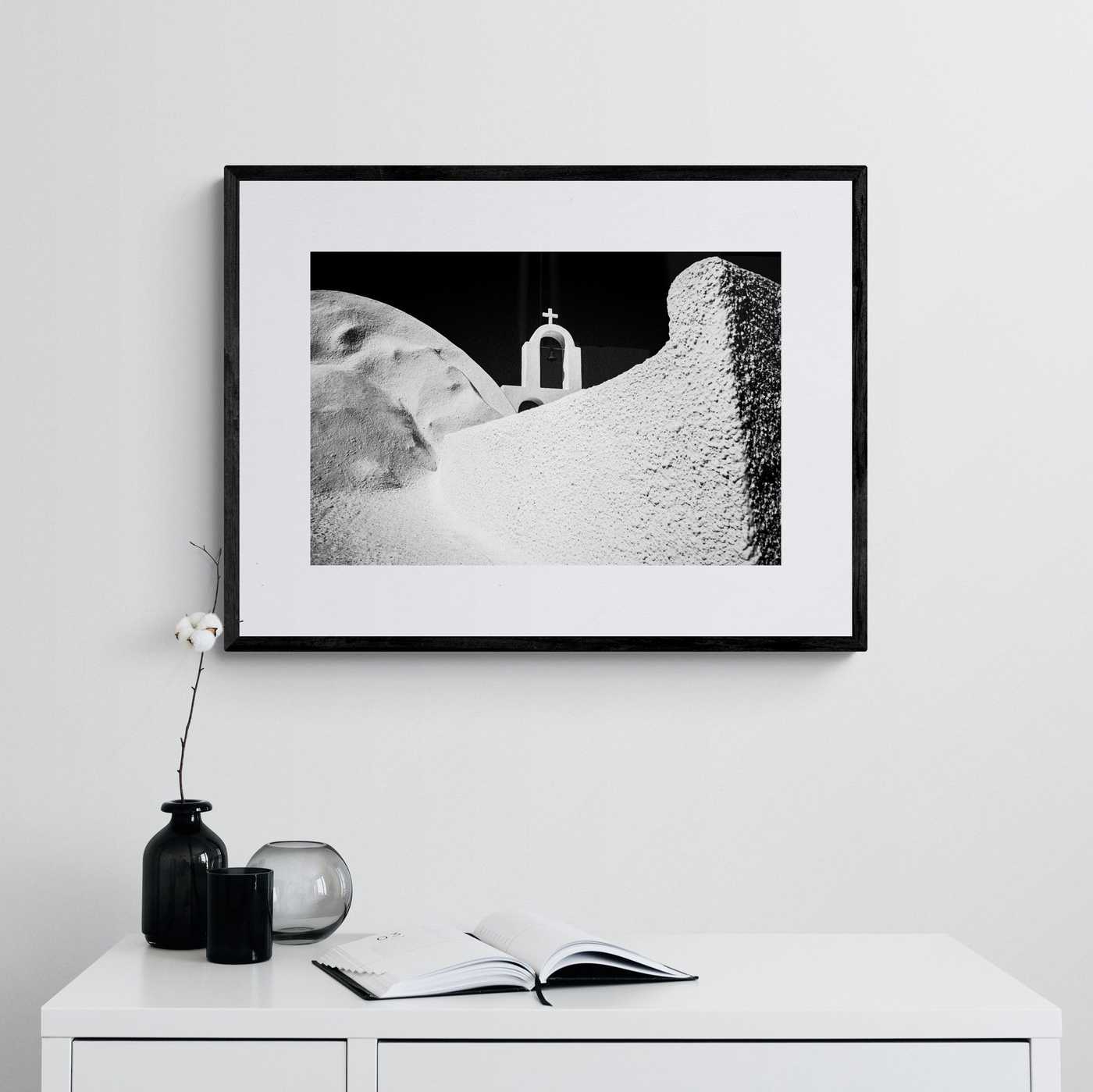


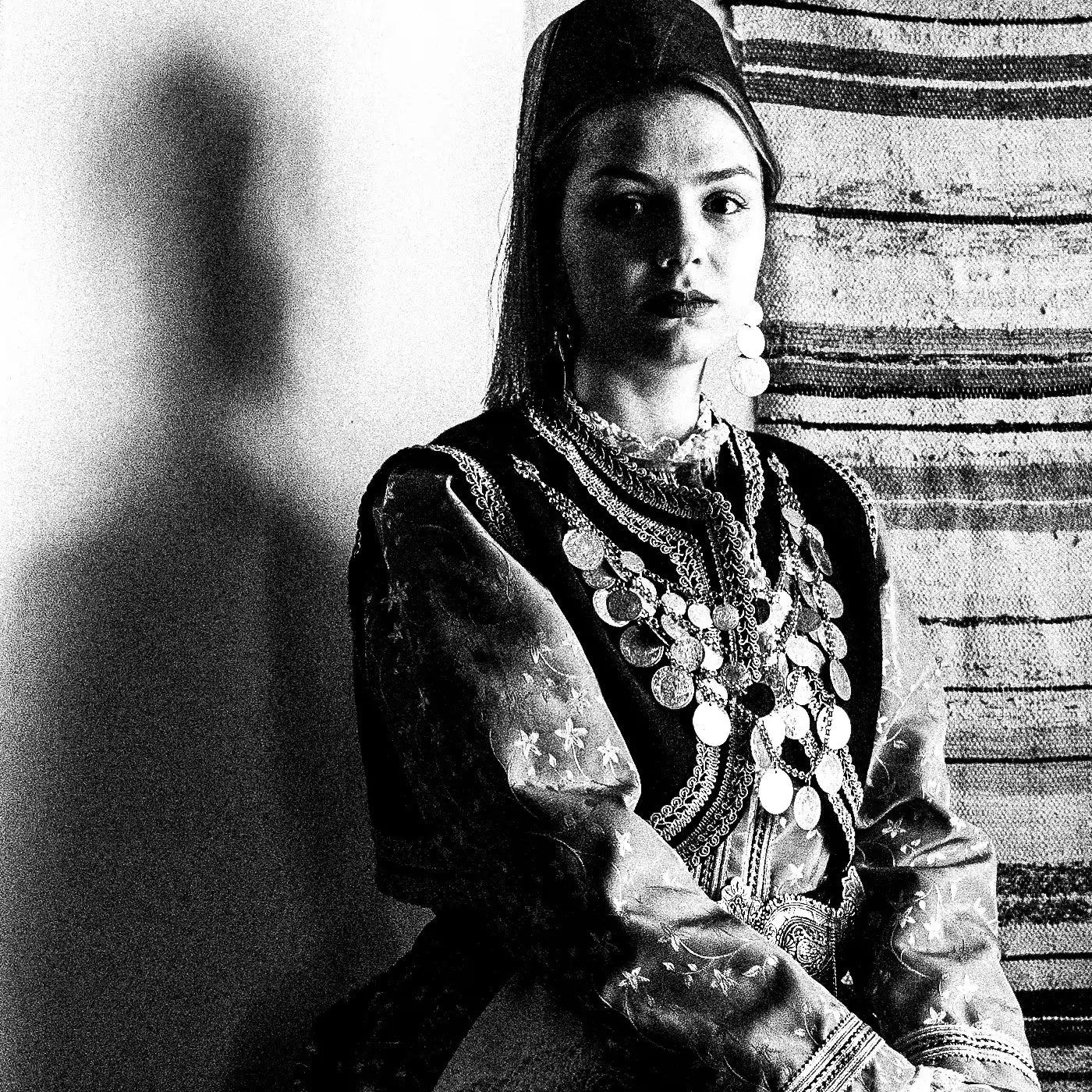

Woman with Attire, Kastoria is a black and white fine art photography print by George Tatakis. From the Caryatis series. Produced on Hahnemühle Baryta Photo Rag 315gsm using archival pigment inks. Open edition, with signed and framed options. Each print is house-stamped on the reverse. Available formats: 30 x 20 cm, 42 x 30 cm, 60 x 42 cm. Choose print only or a black oak frame.
Photographed in Kastoria, this image is structured through contrast, obstruction, and layered depth.
A single figure is positioned slightly off-center, breaking the strict symmetry seen in other compositions. This shift introduces tension while maintaining overall balance.
The space is divided into distinct zones. On the left, a framed portrait leans within the structure of a loom, forming a dense visual block. On the right, darker elements partially obscure the frame, creating a sense of interruption rather than openness.
The subject remains clear within this complexity. Her placement against a lighter wall isolates her form, allowing the costume and posture to remain legible despite the surrounding density.
Foreground elements—most notably the wheel—extend into the lower part of the frame. These forms introduce depth while also partially obstructing the subject, reinforcing the layered construction of the image.
Light enters from the right side, but is partially contained by the interior structure. This creates strong directional contrast, with areas of the frame falling into deeper shadow while the subject remains defined.
The composition does not aim for clarity. It is built on controlled interference between elements.
Part of the Caryatis series, a long-term body of work exploring traditional Greek costume through directed portraiture.