

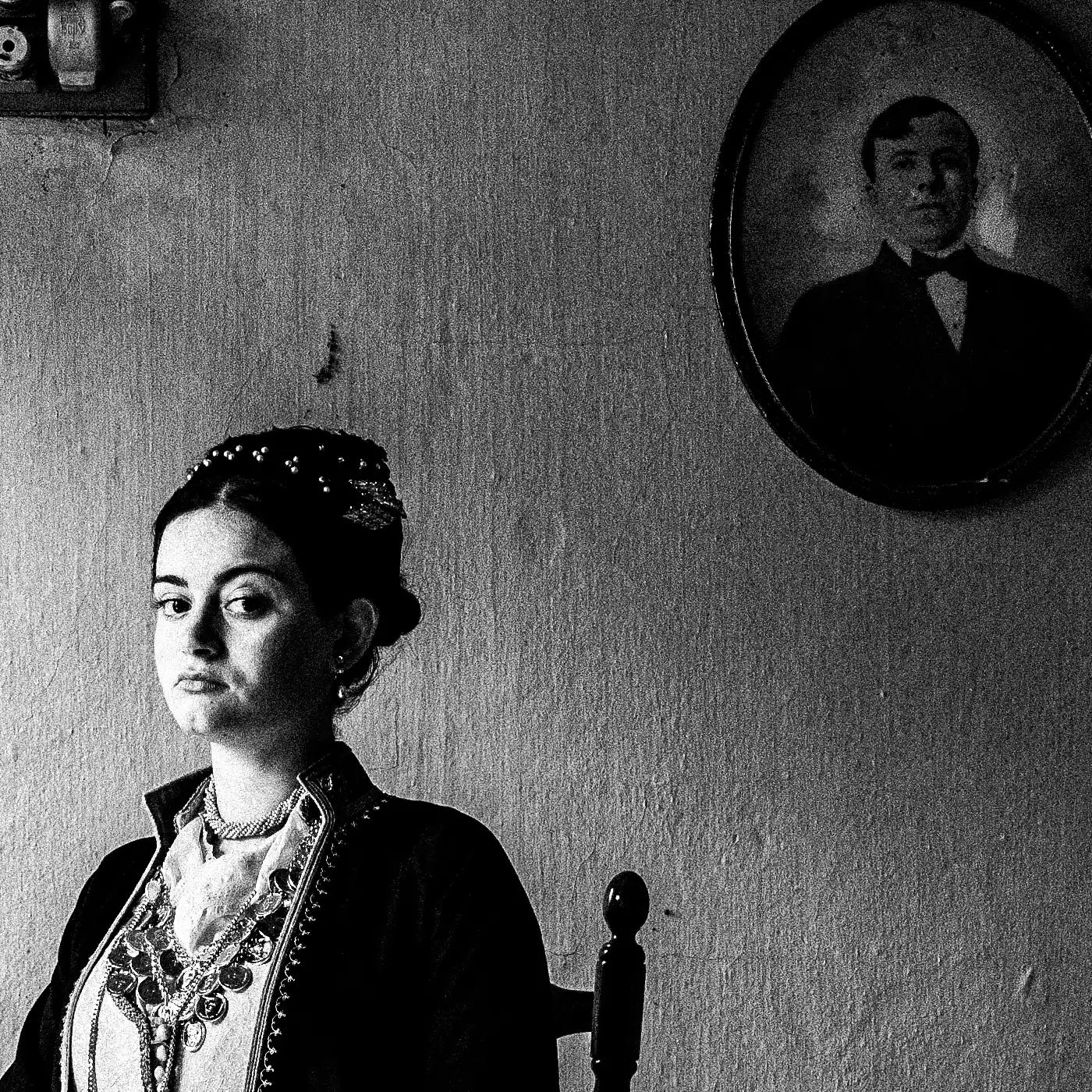

Veria Interior, Veria is a black and white fine art photography print by George Tatakis. From the Caryatis series. Produced on Hahnemühle Baryta Photo Rag 315gsm using archival pigment inks. Open edition, with signed and framed options. Each print is house-stamped on the reverse. Available formats: 30 x 20 cm, 42 x 30 cm, 60 x 42 cm. Choose print only or a black oak frame.
Photographed in Veria, this image presents the local urban costume through isolation, minimal structure, and directional light.
A single seated figure occupies the space. She is positioned slightly off-center, allowing the surrounding environment to remain active within the composition.
The interior is sparse. Walls, floor, and basic furniture form a restrained setting, free of unnecessary elements. This reduction emphasizes the figure and her presence.
Light enters from the left through an open doorway. It defines the composition, illuminating the subject while gradually fading into shadow across the room.
The doorway functions as both a light source and a structural element. It introduces depth and connects the interior with the exterior space beyond.
A secondary opening in the background adds another layer of depth, but remains subdued, ensuring the focus stays on the figure.
The seated posture stabilizes the composition. The vertical lines of the body contrast with the horizontal spread of the floor and walls.
The image is built on quiet control. Light, space, and subject are reduced to their essential relationship.
The costume is an authentic urban attire from Veria, preserved and provided by the Lyceum Club of Greek Women of Veria.
Part of the Caryatis series, a long-term body of work exploring traditional Greek costume through directed portraiture.