

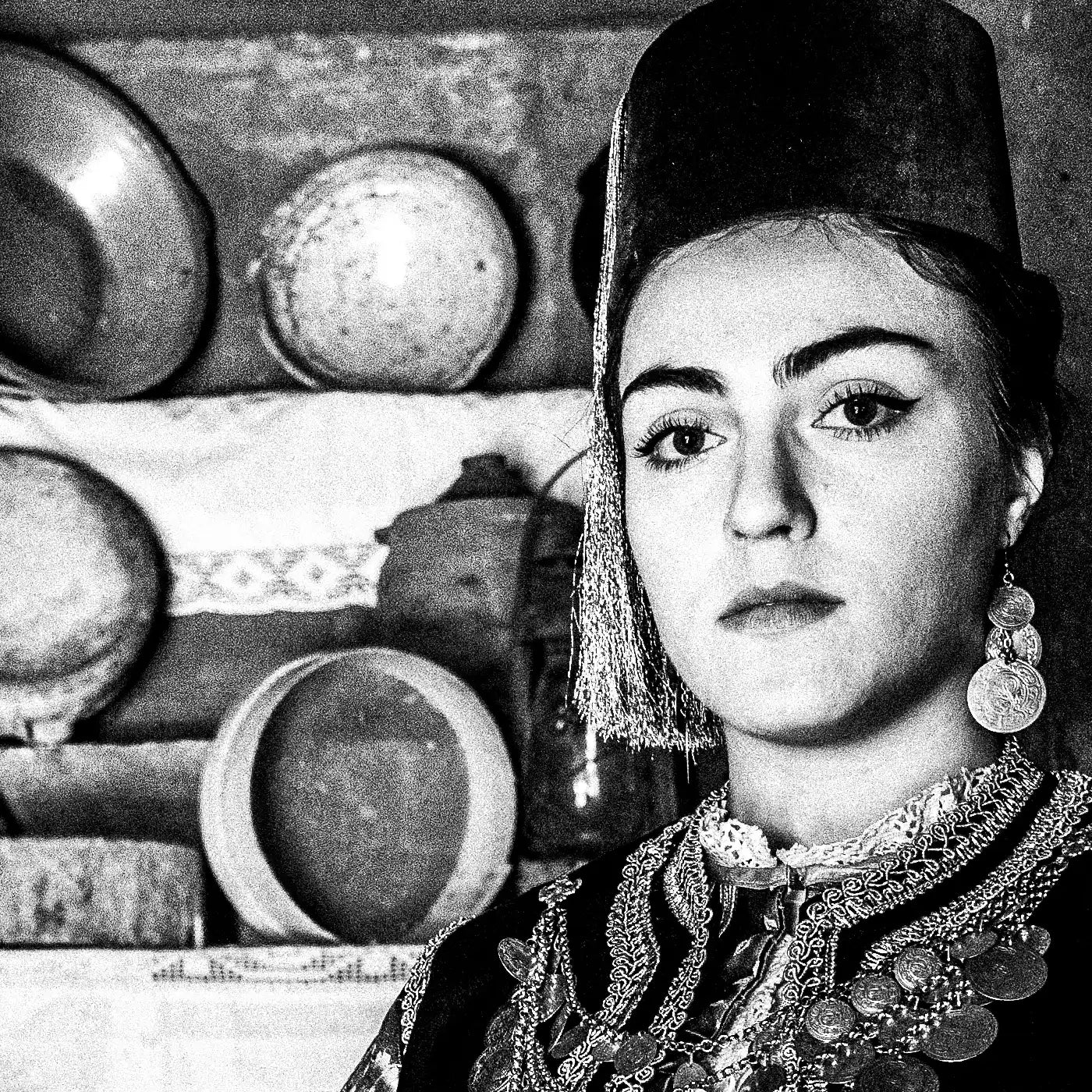

Dual Portrait, Kastoria is a black and white fine art photography print by George Tatakis. From the Caryatis series. Produced on Hahnemühle Baryta Photo Rag 315gsm using archival pigment inks. Open edition, with signed and framed options. Each print is house-stamped on the reverse. Available formats: 30 x 20 cm, 42 x 30 cm, 60 x 42 cm. Choose print only or a black oak frame.
Photographed in Kastoria, this black and white image is structured through dual presence, tonal contrast, and controlled spatial compression within an interior setting.
Two figures are positioned across the frame, separated laterally while remaining visually connected. The figure in the foreground stands closer to the lens, sharply defined and occupying the right side. The second figure is placed deeper in the space, slightly offset to the left, creating a clear distinction in depth.
The composition is built on contrast. The foreground figure emerges from shadow into light, with the garments and facial features clearly articulated. The background figure is more evenly lit, integrated into the surrounding environment. This difference establishes a hierarchy between the two.
The environment plays an active role. Objects arranged within the wall recess form a contained cluster behind the figures, introducing a secondary focal point. The surrounding surfaces—dark, textured, and uneven—create a dense backdrop that isolates the figures and emphasizes their presence.
Balance is achieved through asymmetry. The visual weight of the foreground figure is countered by the positioning of the second figure and the distribution of objects behind her. The frame remains stable without relying on symmetry.
Light enters from the front left, defining the form of the foreground figure while gradually diminishing toward the right side of the frame. This directional light enhances separation and reinforces depth.
Part of the Caryatis series, a long-term body of work exploring traditional Greek costume through directed portraiture.