

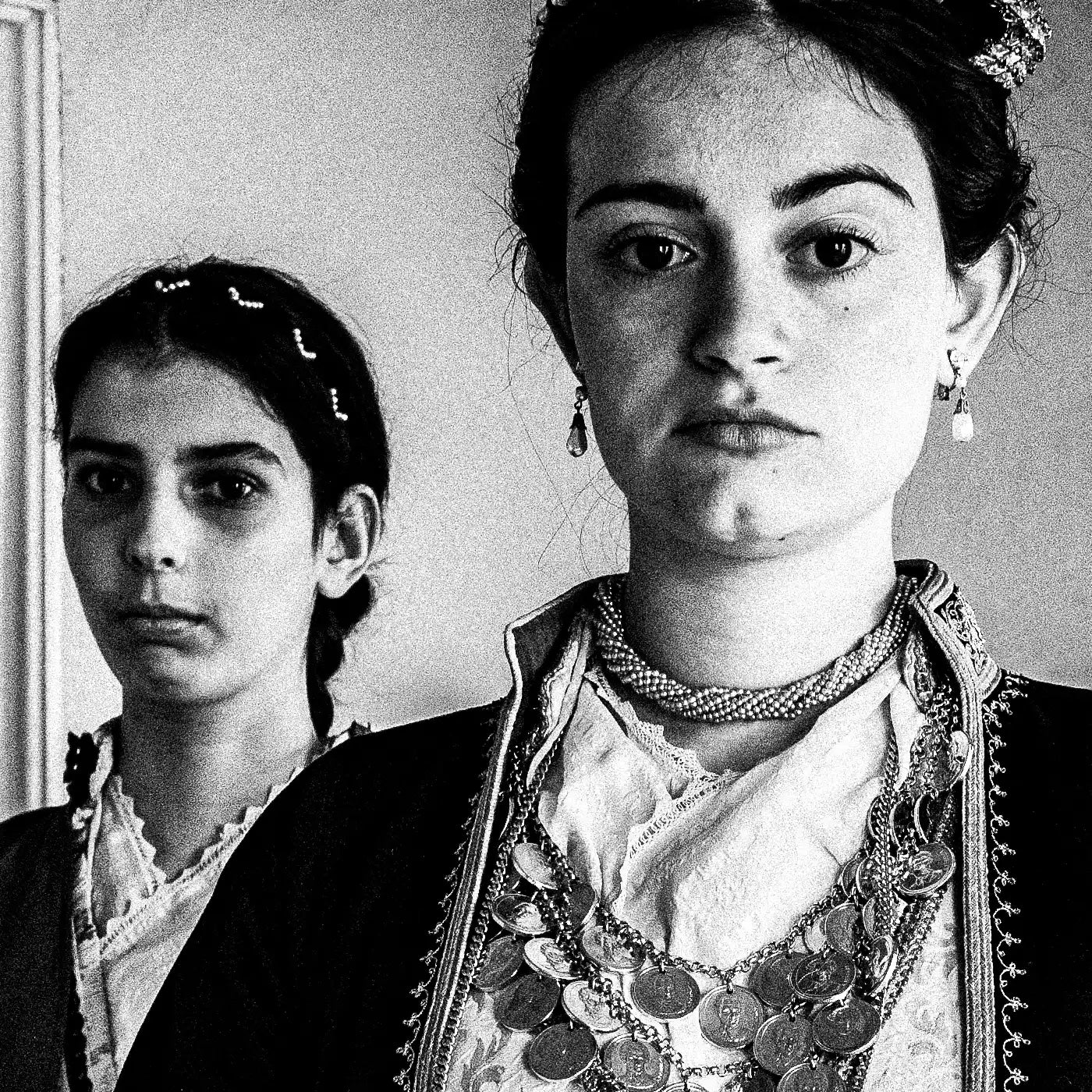

Three Figures Interior, Veria is a black and white fine art photography print by George Tatakis. From the Caryatis series. Produced on Hahnemühle Baryta Photo Rag 315gsm using archival pigment inks. Open edition, with signed and framed options. Each print is house-stamped on the reverse. Available formats: 30 x 20 cm, 42 x 30 cm, 60 x 42 cm. Choose print only or a black oak frame.
Photographed in Veria, this image presents the local urban costume through frontal hierarchy and compressed depth.
A central figure stands closest to the camera, dominating the frame. Her placement is direct and confrontational, establishing immediate visual authority.
Two additional figures are positioned behind her, slightly offset to each side. Their presence creates depth, but the spacing is tight, compressing the scene toward the front.
The composition is structured around a shallow triangular arrangement. Unlike wider groupings, the figures are brought close together, intensifying their relationship within the frame.
Architectural elements—doors and the curved ceiling—form a contained backdrop. These features enclose the figures, reinforcing the sense of compression.
Light enters from the right, shaping the faces and garments while maintaining clarity across all subjects. The illumination supports the hierarchy without isolating the central figure completely.
The image is built on proximity and presence. The subjects are not distributed across space but gathered tightly, creating a direct and concentrated composition.
The costumes are authentic urban attire from Veria, preserved and provided by the Lyceum Club of Greek Women of Veria.
Part of the Caryatis series, a long-term body of work exploring traditional Greek costume through directed portraiture.