


Kotsamania Dance, Tetralofos is a black and white fine art photography print by George Tatakis. From the Ethos series. Produced on Hahnemühle Baryta Photo Rag 315gsm using archival pigment inks. Open edition, with signed and framed options. Each print is house-stamped on the reverse. Available formats: 30 x 20 cm, 42 x 30 cm, 60 x 42 cm. Choose print only or a black oak frame.
Photographed in Tetralofos, Kozani, this image captures the Kotsamania ritual in an open landscape.
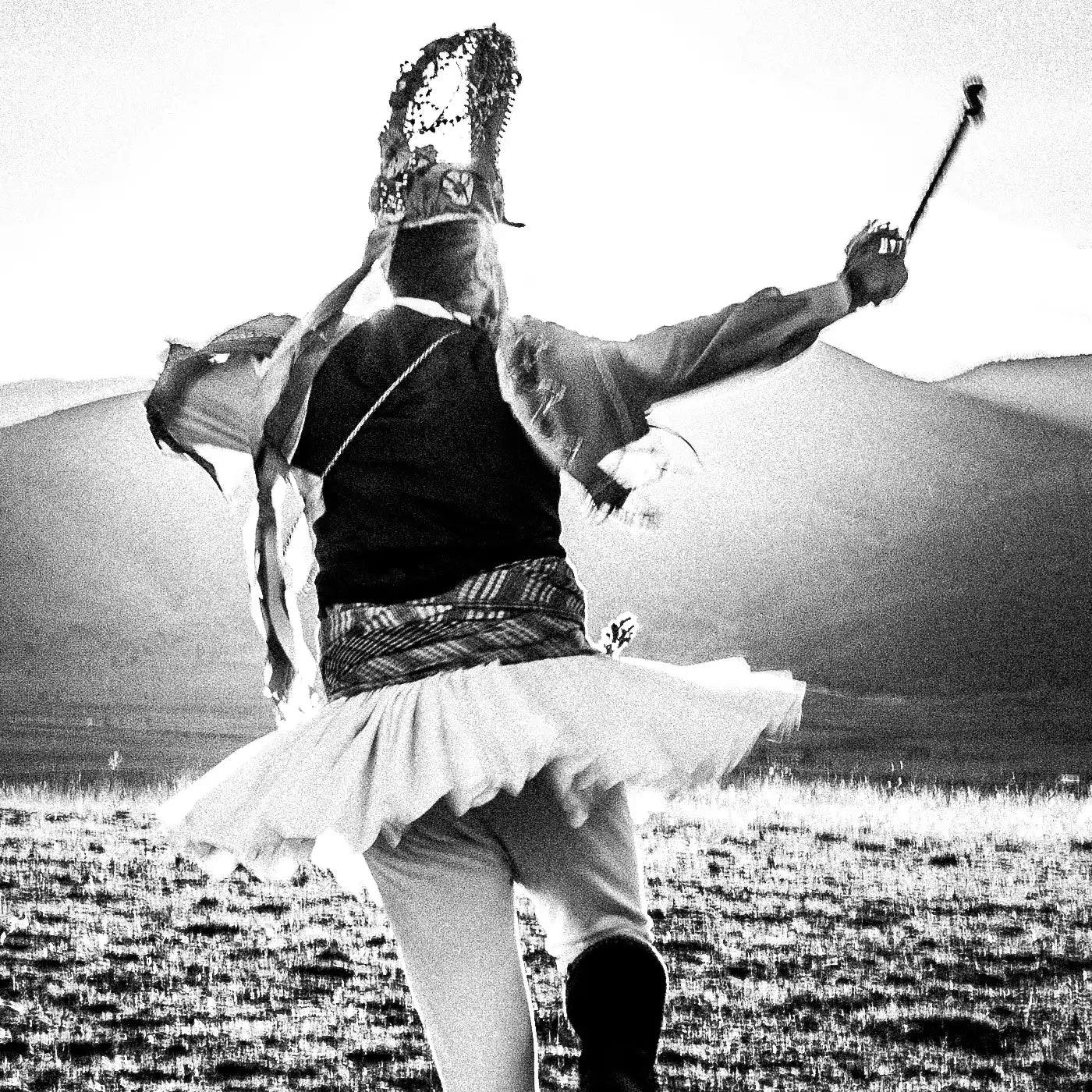
A single figure moves away from the camera, positioned at the center of a wide field. The body is in motion, mid-step, with arms extended.
The composition is built on depth and expansion. The ground stretches forward, leading into distant mountains and open sky.
Light emerges from behind the figure. The subject is partially silhouetted, with a halo effect separating the body from the landscape.
This backlighting reduces detail and emphasizes outline, gesture, and movement.
The costume—traditional Kotsamania attire—remains visible through its structure and volume rather than fine detail.
The figure does not confront the viewer. Movement is directed outward, toward the horizon.
The image operates through openness. There are no enclosing elements, no architectural boundaries.
The terrain, sky, and distance define the composition.
The Kotsamania ritual is rooted in Pontic tradition, associated with performance, satire, and transformation.
Part of the Ethos series, a long-term body of work documenting Greek rituals and cultural practices.