


Kotsamania, Tetralofos is a black and white fine art photography print by George Tatakis. From the Ethos series. Produced on Hahnemühle Baryta Photo Rag 315gsm using archival pigment inks. Open edition, with signed and framed options. Each print is house-stamped on the reverse. Available formats: 30 x 20 cm, 42 x 30 cm, 60 x 42 cm. Choose print only or a black oak frame.
Photographed in Tetralofos, Kozani, this image is part of the Kotsamania ritual, a Dionysian-rooted winter custom preserved in Western Macedonia.
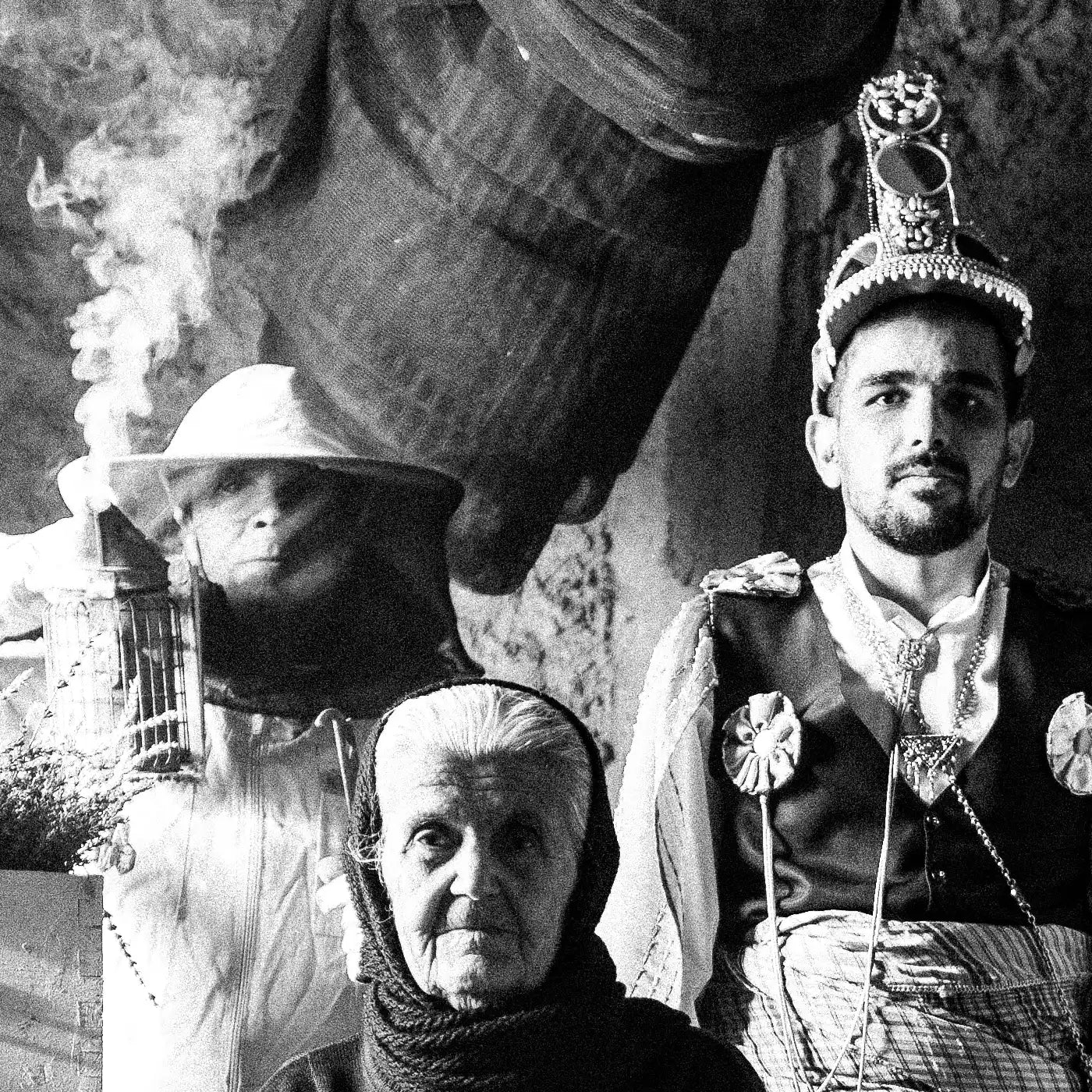
The scene presents a family of beekeepers within their working environment.
At the center, an elderly woman is seated, forming the visual and generational anchor of the composition.
Behind her, two younger men stand in full Kotsamani attire, positioned symmetrically and facing the camera.
Their presence introduces the ritual layer, while the seated figure establishes continuity across generations.
To the left, a beekeeper holds a smoker, partially obscured by smoke rising into the upper frame.
This element defines the family’s profession and connects the ritual to everyday life.
The interior space is structured with wooden boxes, tools, and materials related to beekeeping.
In the foreground, agricultural elements are placed on the ground, reinforcing the relationship to land and production.
Light enters from the left, separating the figures from the background and shaping the tonal hierarchy of the image.
The composition operates on two levels: the ritual identity expressed through costume, and the occupational identity expressed through environment.
In Tetralofos, participation in Kotsamania extends across the entire village, integrating individual roles into a shared cultural structure.
Part of the Ethos series, a long-term body of work documenting Greek rituals and cultural practices.