

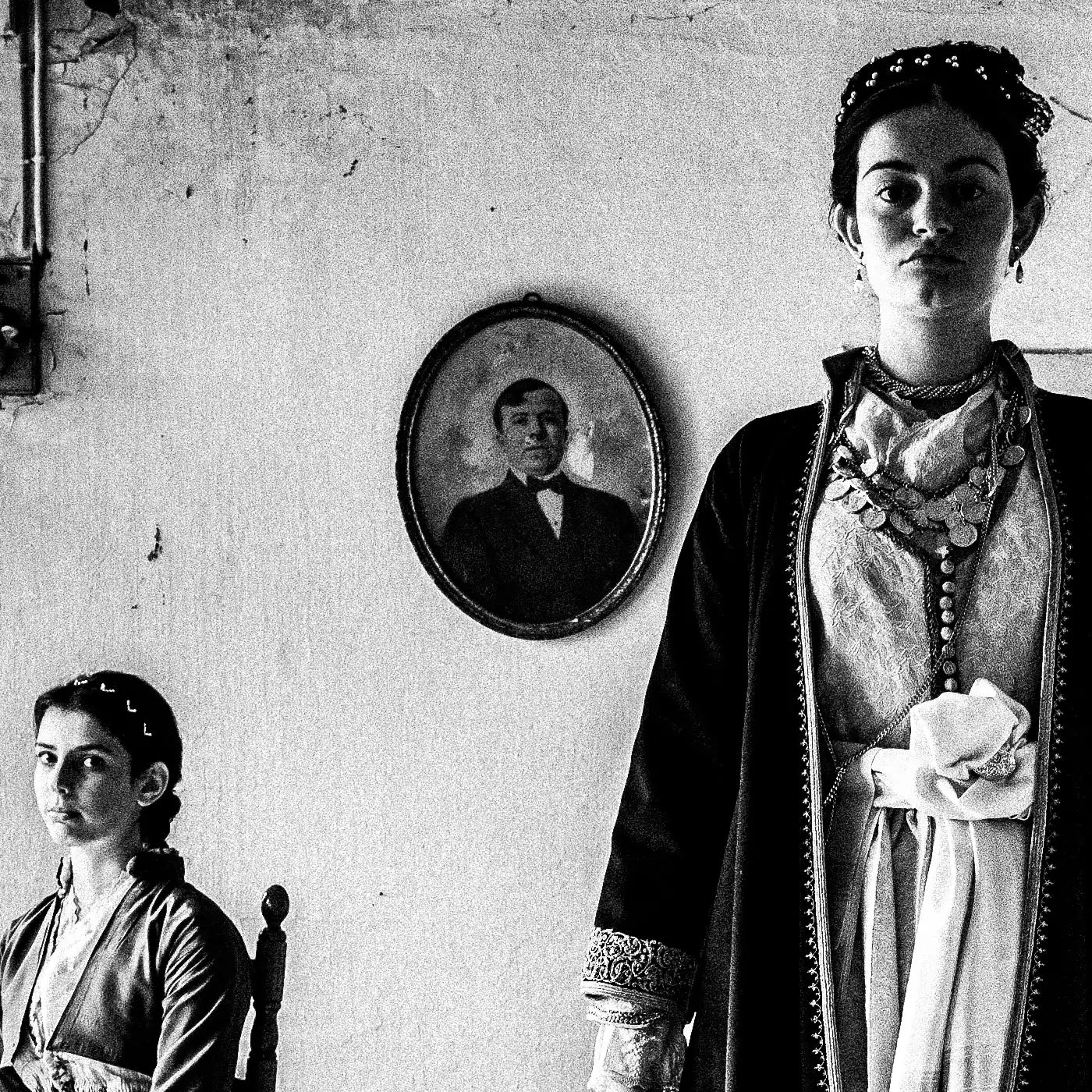
Photographed in Veria, this image presents the local urban costume through depth, sequencing, and spatial progression.
A central figure stands in the foreground, anchoring the composition. Her placement is direct and stable, establishing the primary point of focus.
To the left, a seated figure introduces a secondary presence. Positioned near the doorway, she connects the interior space with the exterior light.
In the background, a third figure appears in a separate room. This extension into another space creates a layered sequence, guiding the viewer deeper into the image.
The composition unfolds across multiple planes. Foreground, midground, and background are clearly defined, each occupied by a figure.
Architectural elements—doorways, walls, and openings—structure this progression. They act as frames within the frame, organizing the movement through space.
Light enters from the left, spreading across the room and gradually diminishing toward the back. This reinforces the depth and directional flow of the image.
The image is built on continuity. Each figure occupies a different layer, forming a connected spatial narrative.
The costumes are authentic urban attire from Veria, preserved and provided by the Lyceum Club of Greek Women of Veria.
Part of the Caryatis series, a long-term body of work exploring traditional Greek costume through directed portraiture.
Museum-quality black and white photography print by George Tatakis, produced on Hahnemühle Baryta Photo Rag 315gsm using archival pigment inks. Open edition, with signed and framed options. Each print is house-stamped on the reverse.