


Two Women, Kastoria is a black and white fine art photography print by George Tatakis. From the Caryatis series. Produced on Hahnemühle Baryta Photo Rag 315gsm using archival pigment inks. Open edition, with signed and framed options. Each print is house-stamped on the reverse. Available formats: 30 x 20 cm, 42 x 30 cm, 60 x 42 cm. Choose print only or a black oak frame.
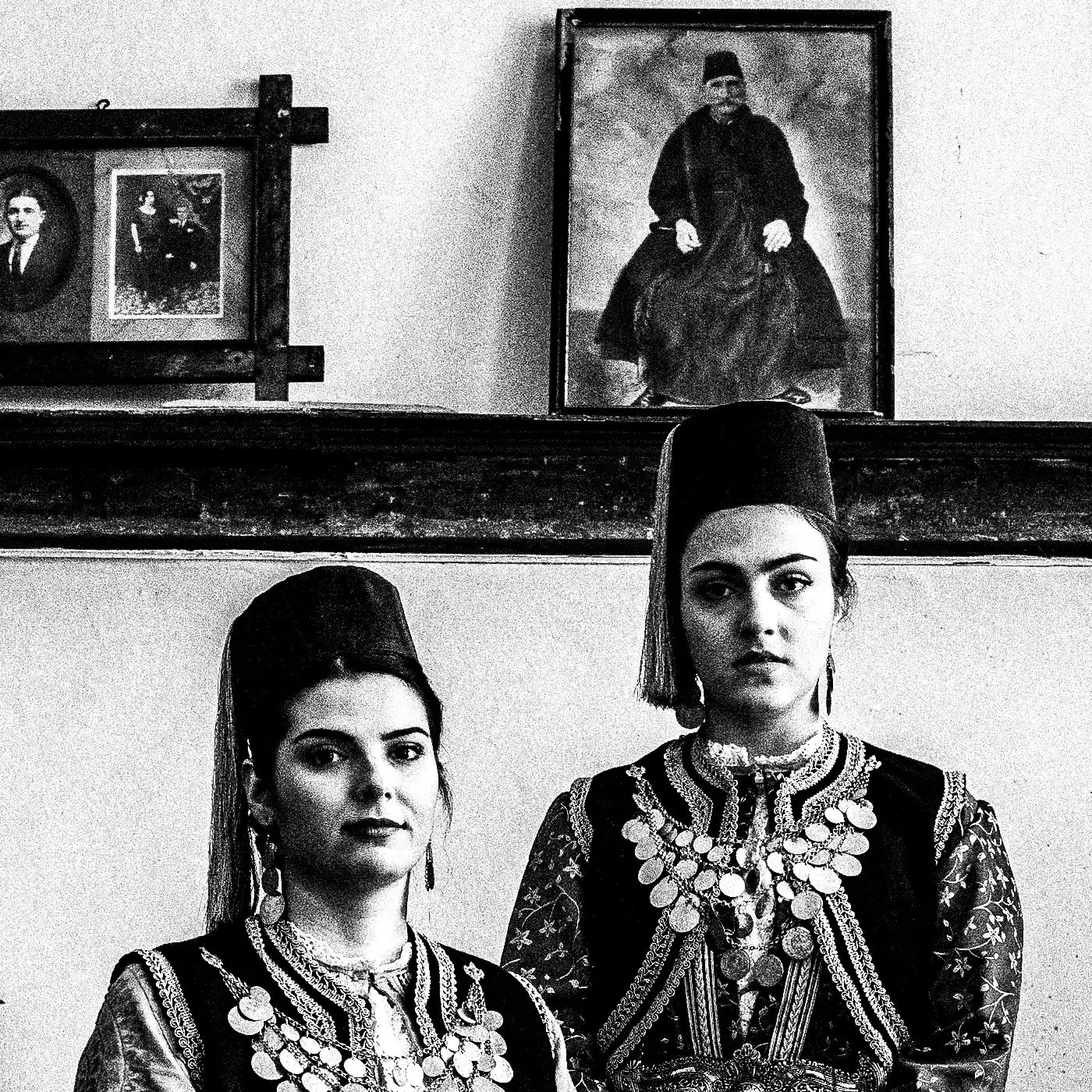
Photographed in Kastoria, this black and white image is structured through restraint, spacing, and controlled alignment within a domestic interior.
Two figures are positioned centrally, one seated and one standing slightly behind. Their arrangement creates a compact vertical unit, clearly separated from the surrounding space. Unlike previous compositions, the figures do not expand across the frame but instead remain contained, allowing the environment to play an equally active role.
The room is organized through horizontal layering. A line of framed photographs and objects runs across the upper wall, establishing a visual boundary above the figures. Below, furniture elements—a desk, shelves, and a resting surface—create a second horizontal structure that stabilizes the composition.
Negative space is critical here. The empty wall surrounding the figures isolates them, reducing distraction and directing attention toward posture, gesture, and costume. The balance is not achieved through symmetry, but through distribution of visual weight across the frame.
Light enters softly from the right side, illuminating the garments and faces without strong contrast. The tonal range remains controlled, allowing texture and detail to emerge gradually rather than through sharp separation.
The relationship between figure and space is quieter, more contained. The composition relies less on tension and more on stillness.
Part of the Caryatis series, a long-term body of work exploring traditional Greek costume through directed portraiture.