

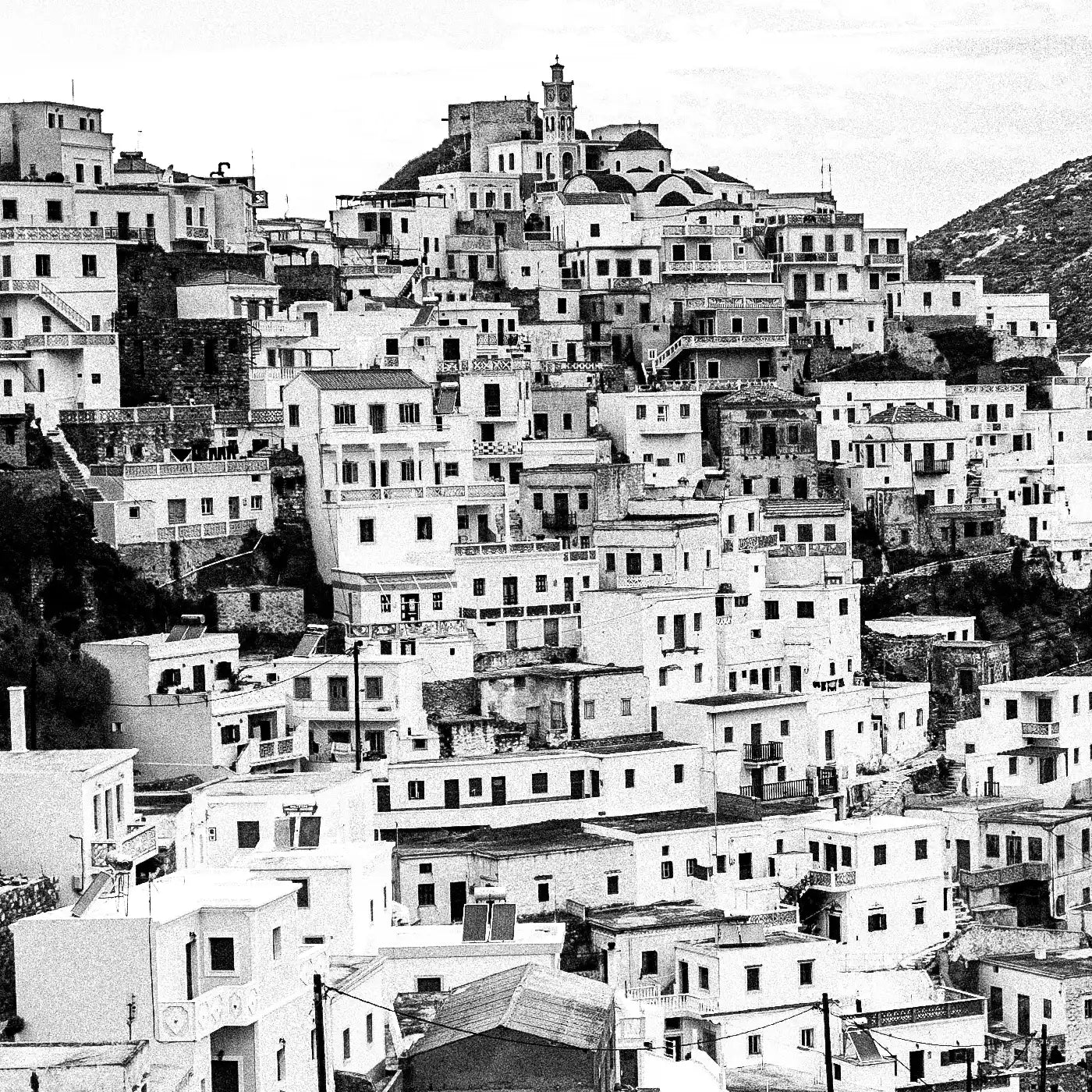
Photographed in Olympos, Karpathos, this image presents the village as a continuous structure rather than a collection of individual buildings.
The settlement unfolds across the slope in dense layers, each house connected to the next, forming a unified mass that follows the geometry of the terrain. The architecture does not impose itself on the landscape; it adapts to it.
The composition emphasizes this relationship. The village occupies the central and left portions of the frame, while the opposing mountain stands on the right, creating a visual counterweight. Between them, the valley forms a natural division that clarifies the structure of the space.
Lines emerge through repetition—paths, walls, and rooftops—guiding the eye through the image without a single dominant focal point. The result is a field of interconnected elements rather than a hierarchy.
Light spreads evenly across the buildings, allowing their forms to remain legible while preserving the density of the construction. The sky introduces movement, contrasting the stability of the village below.
There is no event taking place. The image is concerned with form, placement, and continuity—how a settlement exists within its environment over time.
This photograph is part of Ethos, a long-term body of work documenting traditions and cultural presence across Greece.
Printed as an archival pigment print on Hahnemühle fine art paper.
• Open and limited edition options
• Archival pigment print
• Hahnemühle fine art paper
Available in multiple sizes and formats.